The AI writes nothing
Not one sentence, ever. It underlines. Whether to take a mark or keep your line — and the hands that do the polishing — are always yours.
You write. The desk only underlines.
A scene-based writing desk from the Korean countryside — no account, and the manuscript lives in your own file
What this desk keeps, all the way down
Not one sentence, ever. It underlines. Whether to take a mark or keep your line — and the hands that do the polishing — are always yours.
No account, no server copy. You save to a file on your own computer; the browser only holds a working copy as a crash net. Nothing you write here is ever sent anywhere.
Every underline you take or keep gets a one-tap reason. The reasons accumulate into a quiet picture of your own taste — the real product of this desk.
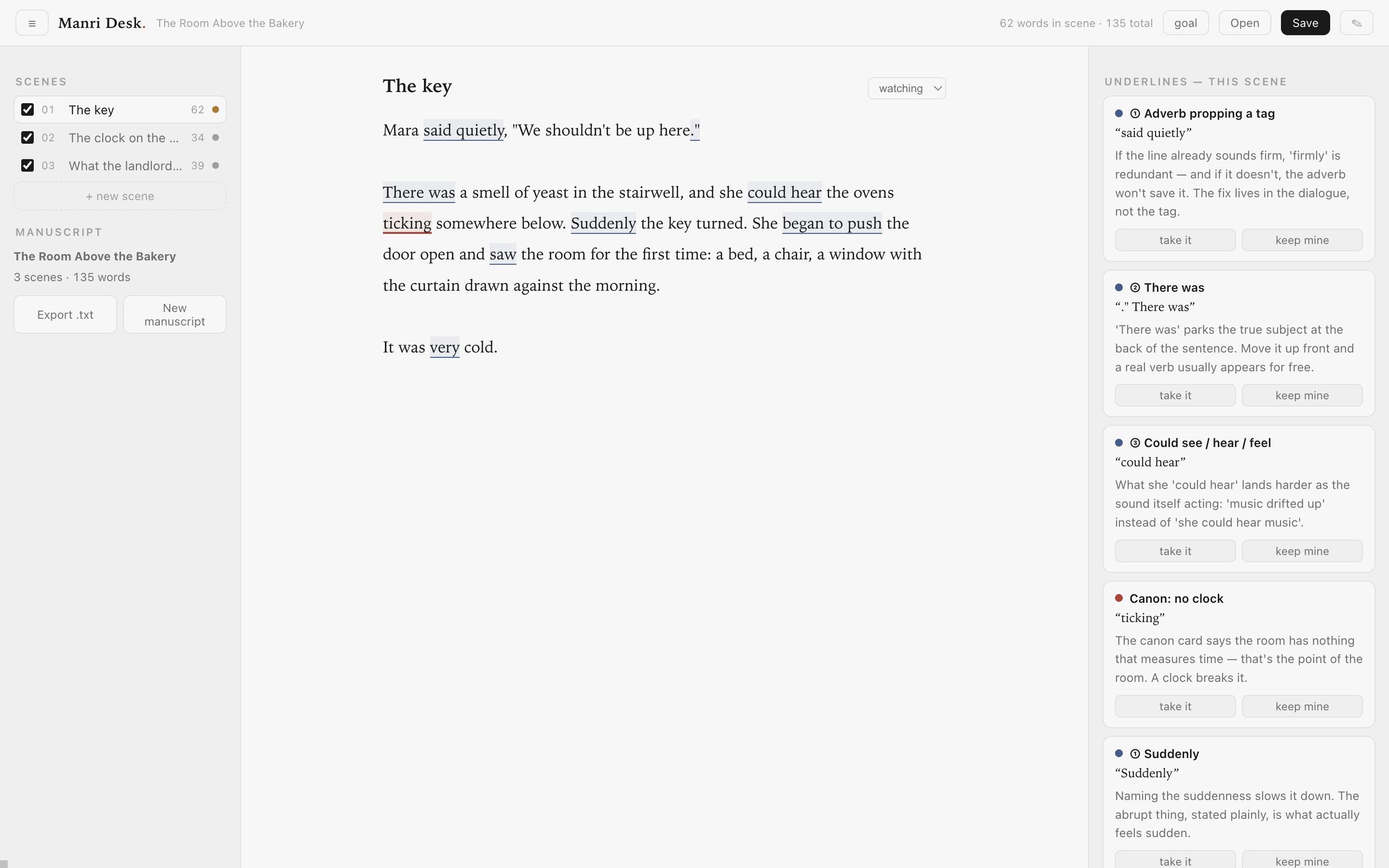
Scenes on the left, manuscript in the middle, judgment on the right — no windows to juggle
 1
2
3
4
5
6
7
8
1
2
3
4
5
6
7
8
Left to right — scenes, manuscript, and judgment
You write in scenes. Each one carries a status light (grey draft · amber watching · green done) and a live word count, so the scene you owe a second look is visible at a glance. Drag to reorder.
Untick a scene and the manuscript recalculates without it — a way to try removing without erasing.
Opening a scene shows the closing lines of the one before it — · · · previously — the actual sentences, never a summary. You land where you left off.
Red pen marks a break in the facts you locked down yourself — a character, a place, a prop. Blue pencil is a hint: an adverb propping up a dialogue tag, a filter word, a suddenly, the same pair of words echoing twice within a few lines.
An underline only shows where the desk snags. Take it / keep mine — and the reason — are entirely yours.
We don't set the rules. You write them. Lock a fact — “the room has no clock” — as a red-pen rule, and the desk guards that fact across the whole manuscript.
The desk arrives with twelve starter pencils, distilled from the editors English prose actually answers to — Elmore Leonard, Stephen King, Strunk & White, Browne & King. All twelve are deliberately hints, never red: promoting habits to violations is how a tool erases a writer's voice.
The things you keep scrolling back to check live on character · place · prop cards — locked facts, kept beside the manuscript.
A twist can be written down too: anything after “Secret:” stays on your desk and never enters an AI brief. If a fact must not drift, set the same fact as a red-pen rule and the desk will hold it for you.
Every verdict takes one reason — “stands without it”, “deliberate echo”, “one-off, not a habit”. The reasons pile up into Your reasons so far: which marks you take, which you wave through, and why.
Under three judgments the desk says nothing at all — it refuses to guess your taste from thin evidence.
⌘S saves the manuscript to your computer as a small .manri.json file — scenes, rules, cards, and your ledger, all in one. That file is the manuscript's home; the browser copy is only a crash net, and cleared site data takes it along.
In Chrome and Edge the desk quietly re-saves to the same file as you work; other browsers get a fresh download. Open moves a manuscript between machines.
Export .docx produces a manuscript-format Word file — Times New Roman 12pt, double-spaced, first-line indents — the file agents and editors actually open. Built right into the page, offline like everything else. Export .txt makes a plain reading copy.
Listen has the desk read the current scene to you — ears catch what tired eyes forgive. It uses only voices that live on your device; cloud voices are refused on principle, because they would ship your text to a server. The manuscript still never leaves your machine, even out loud.
“Copy for your AI” puts a critique brief on your clipboard: the canon cards, the scene, and standing orders — point at lines, name the problem, ask questions, rewrite nothing. Take it to whatever stubborn machine you argue with.
The desk itself has no AI inside. That is not a missing feature — it's the first promise, kept structurally.
From the door to your first judged underline
The manuscript file is plain JSON — readable, portable, yours. No format lock-in: the worst that can ever happen to you here is a text file.
The five that come up